
Last reviewed: November 2026
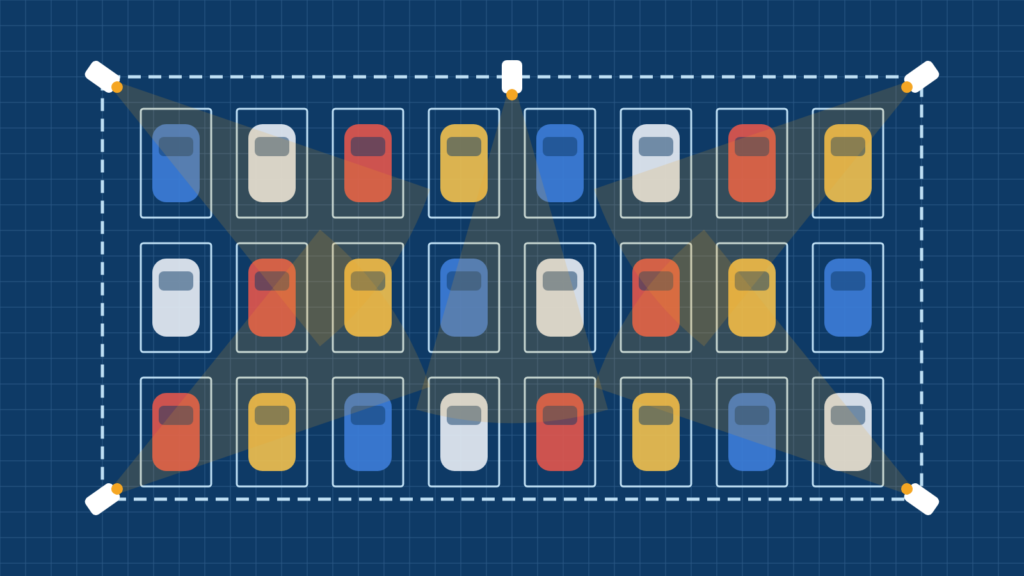
Quick answer: Good car lot security cameras cover every way in first, then the inventory. Put cameras on vehicle and pedestrian entrances, along fence lines, over high-value rows, at the service drive and key areas, and on the building itself. Pair them with even lighting, overlapping fields of view and a plan for who responds when a camera sees someone after hours.
Key takeaways
- Start with approach routes: gates, driveways, fence lines and gaps where people walk in.
- Cover inventory rows with overlapping views so a person cannot work out of sight between vehicles.
- Lighting decides how useful night footage is; plan cameras and lights together.
- Protect the cameras, recorder, power and network, because a disabled system records nothing.
- Placement gives you evidence; live monitoring gives you a chance to respond during the event.
Why does camera placement matter so much on a car lot?
Placement matters because a car lot is wide, open and full of objects that block sight lines. Rows of tall vehicles create blind lanes, lighting is often uneven, and there can be many places to walk in. Research suggests cameras can be effective in this setting: a 2019 systematic review of CCTV research found the largest and most consistent effects in car parks, and larger effects when systems were actively monitored rather than only recorded.
The ASU Center for Problem-Oriented Policing guide on thefts of and from cars in parking facilities (Clarke, 2002) also lists poor lighting, missing fencing and pedestrian throughways as risk factors, and notes that lots within sight of nearby shops had lower theft rates. Cameras work best on a lot that is already well lit and well bounded.
Vehicle theft is down nationally but still common. The National Insurance Crime Bureau reported 659,880 vehicles stolen in the U.S. in 2025, a 23% drop from 2024 and still about one every 48 seconds.
Where should cameras go on a car lot? A placement checklist
Cameras should go where people enter, where valuable things sit and where staff handle keys. Use this checklist on a site walk, ideally once by day and once after dark.
Entrances and perimeter
- Every vehicle entrance and exit, with a view that can capture a plate as it passes.
- Pedestrian gaps, sidewalks and any spot where the fence is low, damaged or easy to climb.
- Long fence lines, with cameras looking along the fence rather than straight across it.
- Neighboring lots, alleys or wooded edges that give cover to someone approaching.
Inventory rows
- High-value rows such as new trucks, performance models and vehicles with expensive wheels.
- The ends of each row, so movement between vehicles is visible from at least one angle.
- Overlapping views so no area depends on a single camera.
- Pre-owned and overflow lots, which are often farther from the building and less lit.
Building and service areas
- Service drive doors, bays and parts storage.
- Key drop boxes, key cabinets and the rooms where keys are kept.
- Showroom doors and glass, roof access and rear doors.
- Detail and wash areas, which often have vehicles parked overnight with less attention.
The system itself
- Recorder or network equipment in a locked space, with a camera on that space.
- Power and network cables protected, and cameras mounted high enough to be hard to reach.
- A backup plan if power or internet fails, such as battery backup or cellular failover.
How should you choose camera types and settings?
Choose camera types based on the job each position has to do. A simple rule is to separate wide overview cameras from detail cameras.
| Camera role | Typical use on a lot | Setup tips |
|---|---|---|
| Wide overview | See activity across rows and open areas | Mount high; overlap with neighbors |
| Entrance or plate capture | Identify vehicles entering and leaving | Narrow field of view; tuned for headlights at night |
| Perimeter | Watch along fence lines | Point along the fence; avoid aiming into lights |
| Detail | Key boxes, doors, service drive | Close enough to see faces and hands |
| PTZ (pan-tilt-zoom) | Follow activity across a large lot | Best with a person controlling it in real time |
Whatever the type, check the image at night. Glare from lot lights, headlights and reflective paint can wash out detail. Adjust angles, exposure settings and lighting until a person between two vehicles is clearly visible.
How does lighting affect car lot cameras?
Lighting affects whether night footage shows anything useful. Even, steady lighting across rows helps cameras and makes the lot less inviting to people who want to work unseen. The NICB’s consumer advice to park in well-lit areas reflects the same idea. Avoid bright spots next to deep shadows, check that light poles are on all night, and protect the lighting circuit. In one 2014 case reported by NBC DFW, thieves who took 88 wheels from a Texas dealership cut the gate locks and snipped wires to the light poles.
How do you test car lot camera coverage?
You test coverage by walking the lot the way an intruder would and checking what the cameras actually saw. A short routine:
- After dark, have a staff member walk in through each entrance and along each fence line.
- Have them stop between vehicles in several rows, including the far corners of overflow lots.
- Review the footage the next day and note any gaps, glare or spots where a person was hard to identify.
- Adjust camera angles, add a camera or add lighting where needed, then repeat the walk.
- Repeat after inventory layouts change, after construction and when seasons change foliage or daylight.
What should happen when a camera sees someone after hours?
Someone should look, decide and act within minutes. Decide in advance who receives alerts, what counts as suspicious, when to call police and who at the dealership gets the next call. Without that, cameras mostly produce evidence for the next morning. Our guide to monitored vs unmonitored cameras explains the difference, and our article on voice-down deterrence covers how live warnings through speakers work. Rules on audio recording and signage vary, so check local requirements.
Frequently asked questions about car lot security cameras
How many cameras does a car lot need?
It depends on lot size, layout and lighting. Count every entrance, fence line, high-value row and key area, then add cameras until each has clear, overlapping coverage at night.
Should car lot cameras record audio?
Audio recording rules vary by state and locality. Check local law before recording audio, and post any signage that is required.
Are wireless cameras good enough for a car lot?
They can be, but distance, interference and power make wired or properly engineered links more reliable. Test signal strength at night under normal conditions.
How long should footage be kept?
Keep footage long enough to cover the time it takes to discover a loss and file a claim. Ask your insurer and check any local requirements.
Next step for your lot
If your cameras already cover the lot but nobody watches them overnight, Strixon offers remote video monitoring for car dealerships. Trained operators verify alerts on live video, can give voice-down warnings through on-site speakers, and call police and your contacts according to a written response plan. Many existing IP cameras can connect after a free compatibility check. Start a free 14-day trial or email contact@strixonwatch.com.
Sources
- Piza, Welsh, Farrington and Thomas, Criminology & Public Policy: CCTV surveillance for crime prevention: A 40-year systematic review with meta-analysis (2019)
- ASU Center for Problem-Oriented Policing: Thefts of and From Cars in Parking Facilities, Guide No. 10 (2002)
- NBC DFW: 88 Wheels, Tires Stolen Off Cars at Galveston Dealership (2014)
- National Insurance Crime Bureau: U.S. Vehicle Thefts Experience Historic Decline (2026)