
Last reviewed: November 2026
Quick answer: Dealership theft prevention overnight comes down to four things: lock down keys so a vehicle cannot simply be driven away, make wheels and high-value parts slower to remove, close and light the perimeter so intruders are seen early, and agree a written overnight response plan so someone acts on alerts while people are still on the lot.
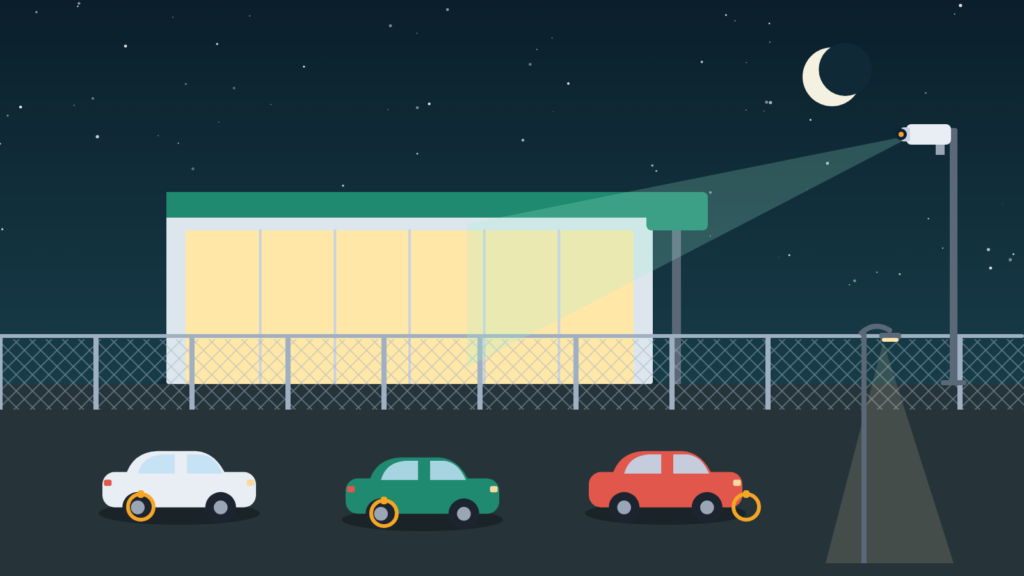
Key takeaways
- Key control is the first line of defense; a stolen key turns a theft into a quick drive-off.
- Wheel locks, row layout and lighting slow down wheel and parts theft.
- Fence lines, gates and lighting determine how early an intruder is seen.
- Cameras do more when someone watches and responds, not just records.
- Write the overnight response plan down before you need it: who is called, in what order, and when police are called.
Why are dealerships targeted overnight?
Dealerships are targeted overnight because they hold many valuable vehicles and parts in one place, often on open lots that are empty for many hours. National numbers are improving: the National Insurance Crime Bureau reported 659,880 vehicles stolen in the U.S. in 2025, a 23% decrease from 2024. Even so, NICB says a vehicle is still stolen every 48 seconds, and it stresses that vigilance and prevention remain key for businesses as well as families.
Overnight losses at dealerships are not limited to whole vehicles. Wheels, tires, catalytic converters and other parts can be taken in bulk. In one case reported by NBC DFW in 2014, thieves cut the locks off a Texas dealership’s gates, snipped wires to the light poles and took 88 wheels from 22 new vehicles while the store was closed.
How do you secure keys overnight?
You secure keys by making sure no working key or fob is reachable on the lot or in an easy-to-enter building. Practical steps:
- Store all keys and fobs in a locked key cabinet or electronic key system inside a secured room.
- Check in every key at close and reconcile counts before staff leave.
- Never leave keys in vehicles, visors, consoles or lock boxes on the lot.
- Restrict who can access keys after hours, and change codes when staff leave.
- Put a camera on the key room door and the key cabinet.
- Secure service drive keys and customer vehicles left overnight with the same care as inventory.
NICB’s general advice to always take your keys and to consider layers like steering wheel locks, alarms, kill switches and GPS trackers applies to dealer inventory too, especially for models that are frequently stolen.
How do you reduce wheel and parts theft?
You reduce wheel and parts theft by slowing thieves down and making them easier to see. D.C. police tips reported by WTOP in 2023 include lug nut locks, tilt-sensing alarms that detect a vehicle being jacked up, parking in busy and well-lit areas with cameras, and turning wheels so lug nuts are harder to reach. For a dealership, that translates into:
- Fitting wheel locks on high-risk models, and keeping lock keys inside, not in the vehicle.
- Parking vehicles with expensive wheels closer to the building and under lights.
- Parking tightly in rows so there is less room to work with a jack.
- Placing barriers or vehicles to block easy access lanes at night.
- Checking the lot at close for anything unusual, such as blocks, tools or cut fencing.
How do you harden fence lines and gates?
You harden fence lines and gates by limiting entry points, removing hiding places and making approaches visible. Steps that help:
- Walk the perimeter and fix gaps, damaged sections and spots that are easy to climb.
- Lock every gate at close with good-quality locks, and use barriers or posts across driveways.
- Trim vegetation and remove stored items that give cover near the fence.
- Light the fence line and gates evenly, and protect the lighting circuits.
- Place cameras to look along the fence and at each gate, with overlapping views.
What should an overnight response plan include?
An overnight response plan should say who watches, what counts as an event, and exactly what happens next. Write down:
- The hours covered, including holidays and weekends.
- Who receives alerts and how quickly they are expected to review them.
- What is suspicious: people on the lot, vehicles at gates after close, activity near key rooms.
- When to give a warning, when to call police, and who at the dealership is called and in what order.
- How evidence is saved and shared with police and your insurer.
Police response policies differ between departments, and many treat verified, in-progress reports differently from unverified alarms. Our guide on why verified alarms change how police respond explains the background; check with your local department about its policy.
How do the main overnight options compare?
Each option has strengths and trade-offs. Many dealers combine more than one.
| Option | Strengths | Trade-offs |
|---|---|---|
| Recording cameras only | Evidence after the fact | Theft is often found the next morning |
| Staff checking alerts by phone | Low added cost | Relies on someone waking up and judging alerts |
| On-site guard | Physical presence on the lot | One person cannot see every row at once; ongoing staffing cost |
| Mobile patrol | Visible, unpredictable visits | Gaps between visits |
| Remote video monitoring | Operators watch many cameras during set hours and can respond during an event | Needs good camera coverage and lighting |
Research supports pairing cameras with other measures. A 2019 systematic review of CCTV studies found the largest and most consistent effects in car parks, larger effects for actively monitored systems than passive ones, and better results when CCTV was combined with other interventions.
What should you do the morning after a theft?
If you discover a theft in the morning, keep the scene undisturbed and report it to police promptly. Then:
- Save all camera footage from the night, including cameras that may have caught vehicles on nearby roads.
- List affected VINs, stock numbers and missing parts or keys.
- Notify your insurer and keep copies of every report.
- Walk the perimeter to find how thieves got in, and fix it before the next close.
- Update your overnight response plan with what you learned.
Frequently asked questions about dealership theft overnight
What is most often stolen from dealerships overnight?
It varies by area. Whole vehicles, wheels and tires, catalytic converters and parts are common targets. Ask your local police and insurer what they are seeing nearby.
Do wheel locks stop wheel theft?
They slow thieves down and require a special tool to remove, but determined thieves can defeat them. Use them alongside lighting, layout and monitoring.
Should we hire a guard or use video monitoring?
It depends on lot size, layout and budget. A guard provides physical presence, while remote monitoring can watch many cameras at once. Some dealers use both.
How often should we review the overnight plan?
Review it after any incident, when staff change, when the lot layout changes and before holiday periods.
Protect your lot tonight
Strixon provides remote video monitoring for car dealerships. Trained operators verify alerts on live video, can give voice-down warnings through on-site speakers, and call police and your contacts according to a written response plan. Operators can also run virtual guard tours of your cameras. You receive time-stamped incident reports with clips. Many existing IP cameras can connect after a free compatibility check. Start a free 14-day trial or email contact@strixonwatch.com.
Sources
- National Insurance Crime Bureau: U.S. Vehicle Thefts Experience Historic Decline (2026)
- WTOP: DC police offer tips to stem recent rise in tire and rim thefts (2023)
- NBC DFW: 88 Wheels, Tires Stolen Off Cars at Galveston Dealership (2014)
- Piza, Welsh, Farrington and Thomas, Criminology & Public Policy: CCTV surveillance for crime prevention: A 40-year systematic review with meta-analysis (2019)