
Last reviewed: November 2026
Quick answer: Voice-down deterrence is when a remote operator watching voice down security cameras speaks live through an on-site speaker to someone who should not be there, often describing what they are wearing and doing. It can work well because it tells the person a real human is watching right now, but it is not a guarantee and works best alongside other security measures.
Key takeaways
- Voice-down means a live person speaks through a speaker on site, not a pre-recorded siren or message.
- Its purpose is to raise the perceived risk of being caught, which is a core idea in situational crime prevention.
- It works best on open lots and yards where intruders can be seen before they reach anything valuable.
- It has limits: it needs clear camera views, audible speakers and a plan for what happens if the person stays.
- Rules on audio, recording and signage vary by location, so check local requirements before installing speakers.
What is voice-down deterrence?
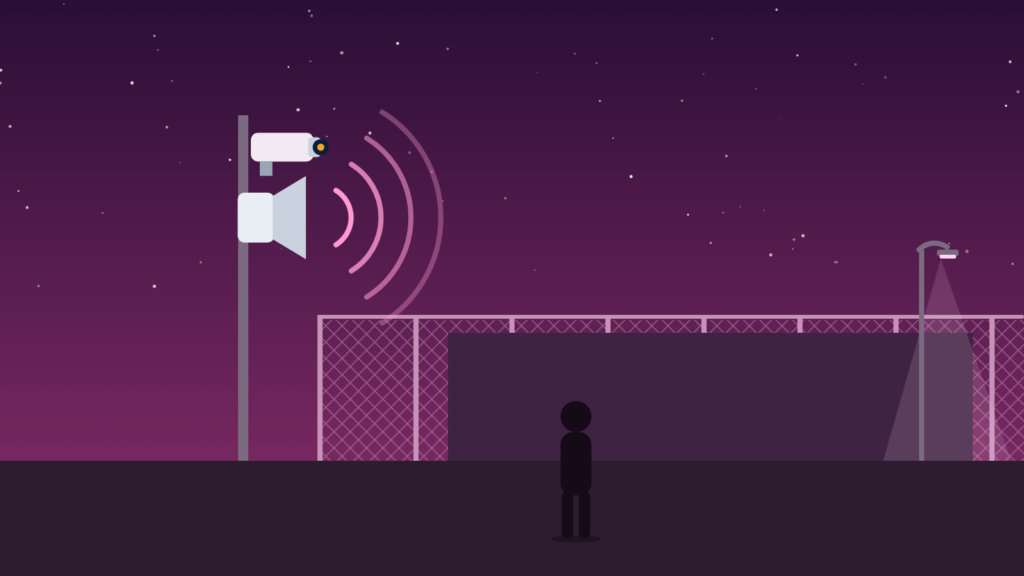
Voice-down deterrence is a live spoken warning delivered through an on-site speaker by an operator who is watching the camera feed. Instead of a generic alarm tone, the person hears something specific, such as a description of their clothing and location, and a statement that they are on camera.
The idea is not new. In the mid-2000s, some UK towns installed “talking” CCTV cameras, with speakers under the cameras so control room staff could address people on the street. Commentary at the time raised questions about using them for minor behavior in public spaces (openDemocracy, 2011). Commercial voice-down today is usually different: it is used on private property, after hours, where nobody should be present.
How does a voice-down warning work, step by step?
A voice-down warning follows a short chain from detection to response. A typical sequence looks like this:
- Detect: camera analytics or a sensor flags movement in a watched zone.
- Verify: a trained operator opens the live feed and decides whether the person is staff, a visitor or an intruder.
- Warn: the operator speaks through the on-site speaker, describing the person and stating that they are being watched.
- Watch the reaction: the operator keeps watching to see whether the person leaves.
- Escalate if needed: if the person stays or the situation is serious, the operator follows the written response plan, which may include calling police and the client’s contacts.
- Report: the event is logged with time stamps and video clips.
At Strixon, operators verify alerts on cameras before speaking, and the response plan agreed with each client decides who gets called and when. You can see the full chain on our how it works page.
Why can a live voice be more effective than a siren?
A live voice removes doubt about whether anyone is really watching. A siren might be set off by wind, and people learn to ignore alarms they hear often. A voice that says “you in the grey jacket by the fence” tells the person they have been seen specifically.
This fits a well-established idea in crime prevention. The Center for Problem-Oriented Policing explains that offenders tend to worry about being caught, and lists “strengthen formal surveillance” as one way to raise that risk (POP Center, Step 40). Research on cameras points the same way: a 2019 systematic review found that actively monitored CCTV schemes produced larger effects on crime than passive systems (Piza et al., 2019). That review did not measure voice-down on its own, so treat it as support for active monitoring in general, not proof of any specific success rate.
Where does voice-down work best, and where does it not?
Voice-down works best where an operator can see someone early and the speaker can be heard clearly. It is weaker where views are blocked, noise is high or the person has already reached the target.
| Situation | How well voice-down tends to fit | Why |
|---|---|---|
| Open construction sites and yards | Good fit | Intruders are visible crossing open ground before reaching equipment |
| Car lots after closing | Good fit | Clear sight lines between rows, and nobody should be there |
| Fence lines and gates | Good fit | Early warning at the edge of the property |
| Busy streets or shared public areas | Poor fit | Hard to tell who is trespassing, and warnings may reach passersby |
| Loud sites with running machinery | Weak | The message may not be heard |
| Areas with poor lighting or blind spots | Weak | The operator cannot describe what they cannot see |
| Determined, organized thieves | Mixed | Some will leave; others may ignore the warning, so escalation matters |
What are the limits of voice-down deterrence?
Voice-down is one tool, not a complete security plan. Be realistic about what it cannot do:
- It cannot physically stop anyone. If a person ignores the warning, the next step is escalation according to your plan.
- It does not control police response. An operator can call police with a verified report, but how and when police respond depends on local policy. Our article on verified alarm police response explains why.
- It depends on equipment. You need an on-site IP speaker that is loud enough and placed where people will hear it.
- It depends on good video. Lighting and camera placement decide whether the operator can see and describe the person.
- Overuse can backfire. Warnings aimed at staff, neighbors or delivery drivers by mistake can cause complaints, so clear schedules and authorized lists matter.
What rules should you check before installing speakers?
Rules that affect voice-down vary by state, province and city, so check locally before you install anything. Points to review include:
- Audio recording: speakers that only play sound are different from devices that also record audio. Laws on recording conversations differ by state, and the Reporters Committee for Freedom of the Press keeps a state-by-state recording guide as a starting point. Ask a lawyer how the rules apply to your setup.
- Signage: some places expect or require signs that video surveillance is in use. Clear signs also help deterrence.
- Noise: local noise ordinances may limit volume, especially at night near homes.
- Lease or HOA rules: landlords and associations may have their own requirements for equipment on buildings.
This article is general information, not legal advice. Rules vary, so check with your local authority or a qualified advisor.
How do you set up voice-down well?
A good setup starts with a written plan and the right equipment in the right places.
- Map the zones where nobody should be after hours, such as fence lines, storage areas and parked equipment.
- Place speakers where they can be heard in those zones, and test the volume at night.
- Make sure lighting and camera angles give a clear view for the operator to describe people.
- List authorized people, vehicles and expected after-hours activity so staff are not warned by mistake.
- Agree what happens after a warning: who gets called, in what order, and when police are contacted.
- Review incident reports regularly and adjust zones or schedules.
If you also want routine camera-by-camera checks, read how virtual guard tours work.
Frequently asked questions about voice down security cameras
Is voice-down the same as a pre-recorded message?
No. A pre-recorded message plays the same words every time. Voice-down is a live operator speaking about what they can see at that moment.
Does voice-down work every time?
No. Some people leave once they realize a real person is watching, and some do not. That is why voice-down should be followed by escalation steps in a written plan.
Can I use my existing cameras for voice-down?
Often you can use existing IP cameras for the video, but you also need an on-site speaker that the monitoring service can reach.
Is voice-down legal?
Playing a live voice through a speaker is not the same as recording audio, but rules on audio, signage and noise vary by place. Check local requirements, or ask a qualified advisor, before installing.
Try voice-down on your site
Strixon is a remote video monitoring company. Trained operators verify alerts on your cameras, give voice-down warnings through on-site speakers, and call police and your contacts according to your written response plan. Every event comes with a time-stamped incident report and clips. See our services, start a free 14-day trial, or email contact@strixonwatch.com.
Sources
- openDemocracy: Sarah Boyes, “Beware your public square: Britain is under attack from ‘talking’ CCTV cameras” (2011)
- Center for Problem-Oriented Policing: Crime Analysis for Problem Solvers in 60 Small Steps, Step 40: Increase the Risks of Crime (2016)
- U.S. Office of Justice Programs (NCJRS): Piza, Welsh, Farrington and Thomas, “CCTV Surveillance for Crime Prevention: A 40-Year Systematic Review with Meta-Analysis,” Criminology & Public Policy (2019)
- Reporters Committee for Freedom of the Press: Reporter’s Recording Guide (accessed 2026)